
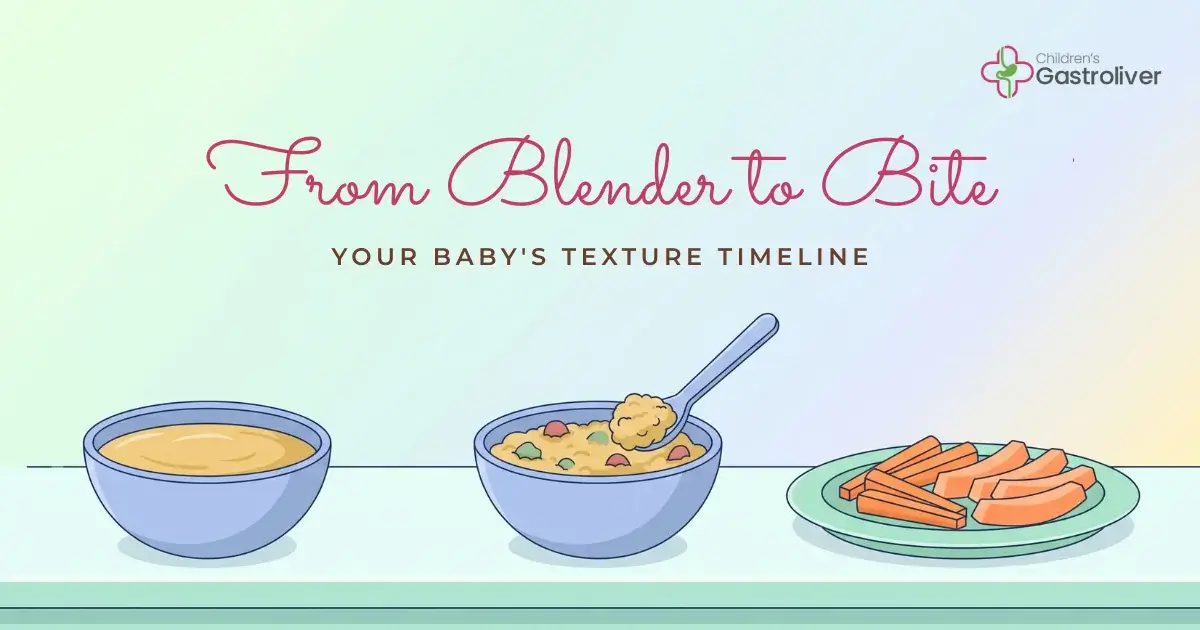
A blender itself won't hurt your baby, but staying on smooth, blended food for too long can. Blending is fine in the first weeks of solid food, and it does not make food unsafe or strip away its main nutrients. What matters is moving on: mashed food from 6 months, soft lumps soon after, soft finger foods by about 8 months, and most family foods by 12 months. Babies who stay on only smooth, runny food past this window can find it harder to accept new textures later.
Why texture matters, not just nutrition
Eating is a skill a baby learns, just like sitting or crawling. Moving food around the mouth, mashing soft lumps with the gums and swallowing thicker food all need practice, and the months between 6 and 10 are when babies pick these skills up most easily.
A large UK study that followed more than 7,000 children found that babies first given lumpy food after 9 months had more feeding problems at age 7, such as picky eating, and ate less fruit and fewer vegetables than babies who started lumps between 6 and 9 months. This was an observational study, so it shows a link, not proof that late lumps caused the problems. It is one reason ESPGHAN (the European pediatric gastroenterology and nutrition society) advises offering lumpy food by about 8 to 10 months, and Health Canada says no later than 9 months.
The texture ladder: what to give and when
These ages are a rough guide. Every baby moves at a slightly different pace, but the direction should always be toward thicker, lumpier food. Babies born premature, or with reflux, food allergy or a developmental condition, may need a plan adjusted by their doctor.
Around 6 months: smooth and mashed
- Blended or finely mashed food is fine at the start, but mix in mashed food early too.
- Examples: mashed banana, mashed boiled potato, thick suji or rice porridge.
6 to 9 months: soft lumps
- Within a few weeks of starting solids, stop blending everything. Mash with a fork or your fingers instead, leaving small soft lumps.
- Examples: hand-mashed khichuri, soft rice mashed with dal, mashed egg yolk, soft fish mashed with rice.
- For fish, choose a large, less bony piece such as rui, and press it between your fingers to feel for bones before mixing it in.
Around 8 months: soft finger foods
- Offer small pieces of soft cooked food your baby can pick up and hold. The piece should squash easily between your thumb and finger.
- Examples: steamed carrot sticks, boiled pumpkin, ripe papaya, soft-cooked potato wedges.
Around 12 months: family food
- Most babies can eat what the family eats, cut small and cooked soft, without added salt or sugar.
Guidelines put the outer limit for lumpy food at about 8 to 10 months, so if your baby is past 9 months and still eats only smooth food, it's time to start stepping up.
Thickness matters too: the spoon test
Many parents add extra water, milk or dal water so food is easy to swallow. A little liquid to soften food is fine. The problem is when the everyday meal becomes thin and runny, because watery food fills a baby's small stomach without giving enough energy and nutrients.
The World Health Organization's simple check: food should be thick enough to stay on the spoon and not drip off. If you tilt the spoon slightly and the food runs off, it is too thin.
Feed with a spoon, not a feeder bottle. Thin porridge or blended food in a bottle stays runny, is easy to overfeed and skips the chewing practice your baby needs.
Blender hygiene in brief: after each use, take the jar, blade and rubber ring apart, wash every part in hot soapy water and let it dry fully. In Dhaka's heat, don't keep blended food out at room temperature for more than an hour; refrigerate it or throw it away.
Safety while moving to lumpier food
- Always sit your baby upright while eating, and never leave them alone with food.
- Do not give whole nuts, whole grapes, popcorn, hard sweets or toffee, hard raw vegetables, or other small, hard, round foods.
- Gagging is normal as babies learn new textures. The baby coughs or makes a retching sound, pushes the food forward, then carries on.
- Choking is an emergency. If your baby cannot cry, cough or breathe, or the lips turn blue, call for help and go to the nearest hospital immediately. It is worth learning infant choking first aid from a trained instructor before you need it.
When to see a doctor
Seek medical care promptly if your baby:
- has breathing difficulty, noisy breathing or coughing fits during feeds
- has repeated chest infections that seem linked to feeding
- is losing weight, or vomits at most meals
Book a routine appointment if your baby:
- keeps refusing all lumpy food after 9 to 10 months despite regular tries
- gags often during most meals
- is not gaining weight well
- was born premature, or has a developmental or neurological condition
A note from Dr. Rafia Rashid
Dr. Rafia Rashid is a pediatrician and pediatric gastroenterologist (FCPS, Pediatrics; FCPS, Pediatric Gastroenterology & Nutrition) with over 18 years of experience, and Assistant Professor at Bangladesh Shishu Hospital & Institute. Her advice to parents whose baby still eats only blended food: don't panic, and don't switch overnight. Small, steady steps toward lumpier food, offered again and again, usually work better than a sudden change.
Frequently Asked Questions
Is it bad to blend baby food?
No. Blending is fine in the first weeks of solids. The concern is staying on only smooth, blended food for too long. Aim for mashed and soft-lumpy food within a few weeks of starting, and soft finger foods by about 8 months.
Does blending destroy nutrients in baby food?
No, not in any way that matters. Blending does not remove energy, protein, iron or fiber. Tiny amounts of some vitamins are lost whenever food is cut, cooked or exposed to air, but that is not a reason to avoid a blender.
When should I stop blending baby food?
Start mashing and leaving soft lumps within a few weeks of beginning solids at 6 months. Guidelines recommend lumpy food by about 8 to 10 months at the latest.
My baby is 10 months old and still eats only blended food. Is it too late?
No. Blend a little less each day, or mash with a fork instead. Mix a small amount of lumpier food into a food your baby already likes, and offer soft finger foods to play with. If your baby keeps refusing or gags a lot, speak to a doctor.
How thick should baby food be?
Thick enough to stay on the spoon without dripping off.
Is gagging the same as choking?
No. Gagging is noisy and normal while learning new textures. Choking is often silent: the baby cannot cry, cough or breathe. Choking needs emergency help right away.
This article is general guidance, not a diagnosis. If your baby is struggling to move beyond blended food, is not gaining weight, or gags or vomits at most meals, consult a pediatric gastroenterologist for a feeding assessment.
References
- Coulthard H, Harris G, Emmett P. Delayed introduction of lumpy foods to children during the complementary feeding period affects child's food acceptance and feeding at 7 years of age. Maternal & Child Nutrition 2009;5(1):75–85.
- Fewtrell M, et al. Complementary Feeding: A Position Paper by the ESPGHAN Committee on Nutrition. J Pediatr Gastroenterol Nutr 2017;64(1):119–132.
- Health Canada, Canadian Paediatric Society, Dietitians of Canada, Breastfeeding Committee for Canada. Nutrition for Healthy Term Infants: Recommendations from Six to 24 Months.
- PAHO/WHO. Guiding Principles for Complementary Feeding of the Breastfed Child, 2003.
- World Health Organization. Infant and Young Child Feeding: Model Chapter for Textbooks for Medical Students and Allied Health Professionals, 2009.
- WHO. Guideline for complementary feeding of infants and young children 6–23 months of age, 2023.
This article is for general information and does not replace individual medical advice.