
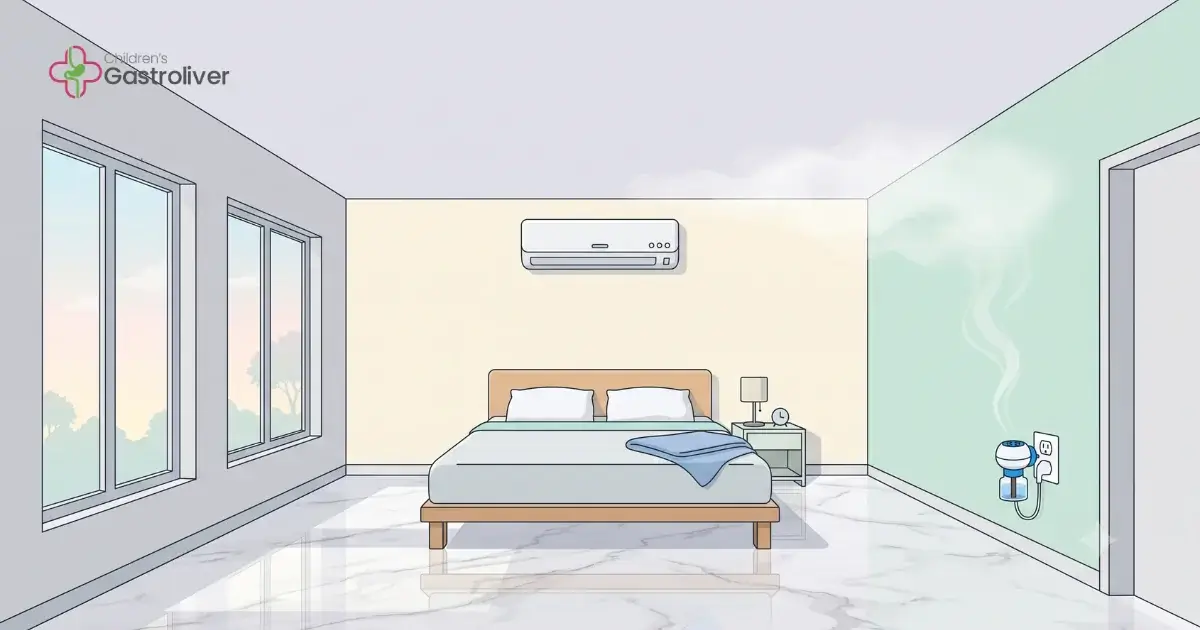
Direct answer: Coils, aerosol sprays, and electric liquid vaporizers all keep mosquitoes away, but none of them are "just scent" — each releases measurable chemicals into your child's bedroom air, and each carries a different, specific risk. Coils burn and release smoke particles linked to asthma and wheezing; electric vaporizers release pyrethroid chemicals linked to skin and eye irritation and, in accidental-ingestion cases, poisoning in toddlers; aerosol sprays put both into the air at once if used while a child is in the room. Knowing which product you're using — and how to use it correctly — matters more than switching between them.
This is part of a two-part series
This article covers what happens to your child's room and airway when you use an indoor mosquito product. A companion article looks at the repellent creams and sprays applied directly to skin — which ones are actually available in Dhaka, and how well they work. Read that one here: Part 2 — Dhaka's Mosquito Repellents, Ranked.
Mosquito coils: what the smoke actually contains
Burning a coil is combustion — and combustion always produces more than the intended smell.
Studies measuring coil smoke have found fine particulate matter (PM2.5), polycyclic aromatic hydrocarbons (PAHs), carbon monoxide, sulfur dioxide, nitrogen dioxide, and trace heavy metals including cadmium, lead, and zinc. In one comparative study, coils sold in the region produced PM2.5 concentrations averaging in the hundreds of micrograms per cubic meter — many times higher than outdoor air quality guidelines, inside a closed room.
What this means for a child: Long-term, repeated exposure to coil smoke has been linked to asthma symptoms and persistent wheezing in children. This isn't about one bad night — it's a cumulative effect from a coil burning in a bedroom several nights a week across a mosquito season.
There's also a lesser-known angle worth knowing, given how closely gut health and airway health are linked in young children: inhaled fine particulate matter doesn't stay in the lungs. Research has shown that airborne particulates can alter the balance of bacteria in a child's gut — a process still being studied, but plausible given that children absorb and swallow a portion of what they inhale, and their gut microbiome is still developing.
Electric liquid vaporizers ("mosquito machines"): a different risk profile
These plug-in devices — sold under several household brand names as liquid vaporizers or mats — don't burn anything. Instead, they heat a liquid refill (usually a synthetic pyrethroid such as transfluthrin or prallethrin, dissolved in a kerosene-based solvent) so it evaporates into the room.
Indoor air impact: Measurements taken during and after vaporizer use show pyrethroid concentrations in room air rising to several orders of magnitude above pre-use levels. These chemicals disperse through the whole room, not just near the device.
Health effects reported in children: Clinical case reports describe dermatitis, eye irritation, and respiratory hypersensitivity following exposure, particularly in children under 6. Public health guidance (WHO and national bodies) specifically recommends using these products only in well-ventilated rooms, for limited durations, and with extra caution around children, pregnant women, and anyone with a chronic respiratory condition.
The risk parents most often miss — accidental ingestion: The refill bottles for these vaporizers look unremarkable and are usually kept at floor or table height, well within a toddler's reach. Case reports of children accidentally swallowing liquid vaporizer refill fluid describe chemical pneumonitis — lung inflammation caused by the kerosene-based solvent entering the airway, sometimes during vomiting after ingestion. This is a real, documented pediatric emergency, not a theoretical risk, and it's rarely mentioned alongside "is this safe to breathe" advice.
If your child swallows any amount of vaporizer refill liquid, treat it as an emergency and go to a hospital immediately — do not induce vomiting.
Aerosol sprays: the products, used correctly and incorrectly
Household mosquito sprays typically combine a pyrethroid insecticide with an aerosol propellant, meant to be sprayed into an empty room and left to settle before anyone re-enters.
The most common mistake is spraying while a child is still in the room, or re-entering immediately after spraying. This delivers a concentrated, fresh dose of the same pyrethroid chemicals discussed above directly into a child's breathing zone, at the moment of highest concentration.
Correct use: Spray only in an empty room, close the door, wait at least 20–30 minutes (check your product's label for the specific time), then ventilate before your child re-enters.
Lower-exposure alternatives worth considering
- Mosquito nets over beds and cots — no combustion, no chemical released into room air, and effective through the whole night.
- Screened windows and doors in bedrooms — a one-time setup that removes the need for nightly chemical use indoors.
- If a coil, vaporizer, or spray is unavoidable, use it in the most ventilated room available, never run it in a fully closed bedroom overnight, and air the room out each morning.
- Store all vaporizer refill bottles and coil packaging out of reach of children, ideally in a locked cabinet — the way you would store any household chemical.
Frequently Asked Questions
Are mosquito coils safe to use in my child's bedroom overnight?
Regular overnight use in a closed room is the highest-exposure scenario. If you use a coil, keep the room ventilated and avoid nightly use in the same closed space over an entire season.
Are electric vaporizer machines safer than coils since there's no smoke?
They avoid the combustion byproducts of coils, but they release their own airborne chemical (a pyrethroid) at concentrations far above baseline room air, and carry a distinct poisoning risk if a child accidentally drinks the refill liquid.
What should I do if my child swallows mosquito vaporizer liquid?
Go to a hospital immediately. Do not induce vomiting, as this can worsen chemical pneumonitis. Bring the bottle so staff can identify the exact ingredient.
Is it true that indoor air pollution can affect more than breathing?
Emerging research links inhaled particulate matter to changes in children's gut bacteria. This is a newer and still-developing area of study, but it's a reasonable additional reason to reduce unnecessary indoor combustion and chemical exposure where practical alternatives (nets, screens) exist.
Which product should I switch to?
There's no perfect option — every indoor mosquito product involves a trade-off. Physical barriers (nets, screens) avoid the trade-off entirely and are the lowest-risk choice for a child's sleeping space.
A note from Dr. Rafia Rashid
Dr. Rafia Rashid is a pediatrician and pediatric gastroenterologist (FCPS, Pediatrics; FCPS, Pediatric Gastroenterology & Nutrition) with over 18 years of experience, and Assistant Professor at Bangladesh Shishu Hospital & Institute. Her whole-child approach is why she asks families not just about a child's symptoms, but about what's in the room they sleep in — including nightly-use products that seem routine but add up in exposure over a season.