
"No salt should be added" — but not literally zero. Babies already get all the sodium they need from breastmilk, formula, and the sodium naturally present in whole foods. What's restricted is adding salt: table salt, salty condiments, stock cubes, dry fish, or salted snacks. This is the consistent position of the WHO, ESPGHAN/NASPGHAN, the AAP, and the UK's NHS — and it matches Bangladesh's own National Dietary Guidelines 2025.
Why Babies' Bodies Can't Handle Adult-Level Salt
A baby's kidneys have a lower filtration rate and immature sodium-handling capacity compared to an older child or adult. That means they can't efficiently get rid of an adult-sized salt load. In the short term, too much salt puts unnecessary strain on the kidneys and raises the risk of dehydration. Longer term, there's concern that early exposure to salty tastes shapes food preferences — and blood pressure patterns — later in life.
What "No Added Salt" Actually Means in Practice
This is where the "zero salt" myth trips parents up. No added salt does not mean flavorless food or panicking over every trace of sodium. It means:
- Don't add table salt, salt-based seasoning cubes, fish sauce, or pickles to your baby's food.
- Limit salty processed and packaged foods — chips, salted biscuits, dry fish, cheese.
- Naturally occurring sodium in vegetables, lentils, meat, fish, and eggs is fine and expected — it doesn't need to be avoided.
The daily total sodium a baby needs — including everything from breastmilk or formula plus food — stays well within a small limit for the first year. As a rough reference point, that's roughly under 1 gram of salt a day for babies 7–12 months old.
The Real Problem: Plain Khichuri That Babies Refuse to Eat
In practice, many Bangladeshi parents run into a different problem: a completely unsalted rice-and-lentil khichuri tastes bland enough that the baby refuses to eat it. A baby who won't eat a nutritionally important meal is a bigger concern than a small, controlled amount of salt.
Dr. Rafia Rashid's practical guidance for this exact situation: a single small pinch of salt — added to the cooking pot, not directly onto the baby's individual bowl — is acceptable, as long as it stays within the daily limit.
A Simple Way to Measure It
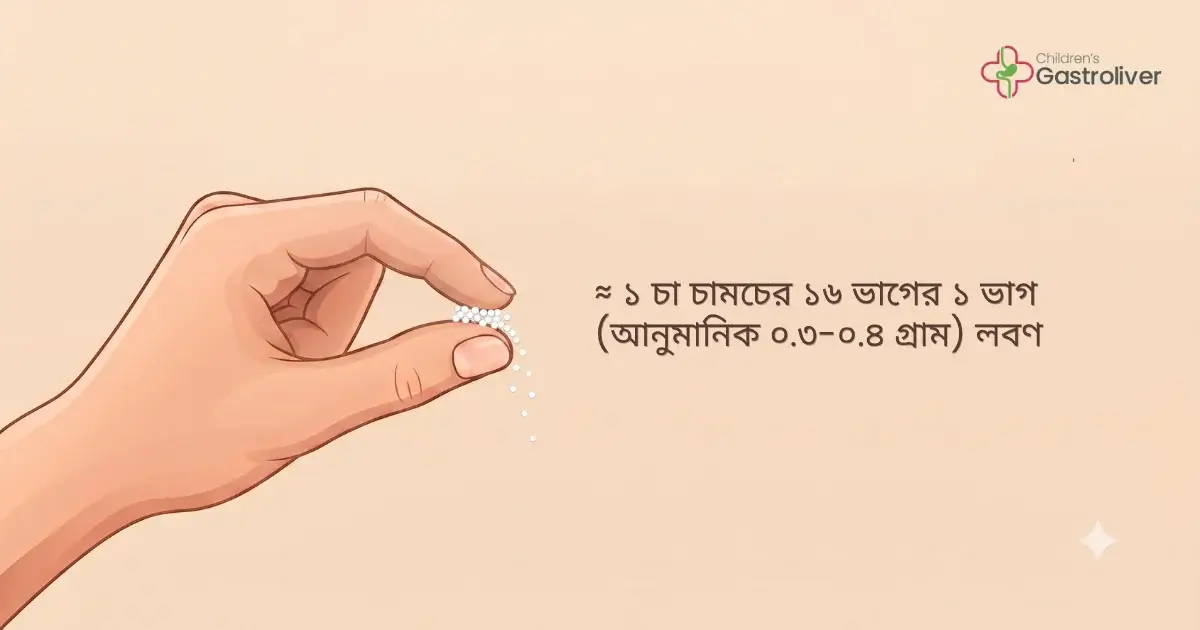
- One standard pinch (thumb and index finger) is roughly 1/16 of a teaspoon — much less than it sounds.
- Add that one pinch to the shared pot of khichuri, not to your baby's bowl directly. Since the pot is divided across several servings, your baby's actual portion works out to roughly a small fraction of that pinch (the exact amount depends on pot size and servings, so this is a helpful approximation, not an exact measurement).
- Never add a full teaspoon directly to a baby's own small portion — that alone is several times the daily limit.
- One-line rule to remember: one small pinch in the pot, not the bowl — never a spoonful.
This is meant as an occasional adjustment for an otherwise-refused meal, not a green light to season your baby's food regularly or generously. Used this way — one small pinch, in the shared pot, now and then — it's usually enough to make the meal palatable without meaningfully changing the baby's daily sodium intake.
An Exception Worth Knowing About
The "no added salt" guidance is for healthy infants with typical digestion. It doesn't apply the same way to children with a stoma (ileostomy/jejunostomy), short bowel syndrome, or conditions causing high fluid and salt losses through the gut. These children can lose sodium faster than they take it in, and may need medical sodium supplementation — under a specialist's guidance — to grow properly. If your child falls into this category, standard "avoid salt" advice does not apply to them the same way, and a pediatric GI specialist should guide sodium intake individually.
A Note From Dr. Rafia Rashid
Dr. Rafia Rashid is a pediatrician and pediatric gastroenterologist (FCPS, Pediatrics; FCPS, Pediatric Gastroenterology & Nutrition) with over 18 years of experience, and Assistant Professor at Bangladesh Shishu Hospital & Institute. In her practice, she regularly guides parents through exactly this kind of real-world trade-off — following the guideline while keeping meals something a baby will actually eat.
Frequently Asked Questions
Does "no added salt" mean zero sodium?
No. Babies get sodium naturally from breastmilk, formula, and whole foods. "No added salt" refers to not actively adding table salt or salty condiments — it isn't a target of zero sodium, which isn't realistic or necessary.
Is a pinch of salt in khichuri really okay?
Yes, used occasionally and in moderation. A single small pinch added to the shared cooking pot (not directly to your baby's bowl) generally stays well within the daily limit for babies over 6 months, and can make an otherwise-refused meal acceptable. This is an occasional adjustment for a specific problem — not a reason to season your baby's food regularly or more generously.
What foods should I avoid instead?
Processed and packaged salty foods are the bigger concern: salted snacks, pickles, dry fish, stock cubes, salted biscuits, and fish sauce. These contain far more sodium per bite than a pinch of table salt in a home-cooked pot.
When should salt be introduced more freely?
Guidelines recommend keeping salt limited through the toddler years too, not just infancy — the daily ceiling increases gradually as children grow, but "salty" processed foods should stay limited well beyond age 1.
Does this apply to every child?
No — children with a stoma, short bowel syndrome, or significant gastrointestinal fluid losses may need more sodium, not less, and should be guided individually by a pediatric GI specialist rather than following the general population's low-salt advice.
References
- WHO Guideline for complementary feeding of infants and young children 6–23 months of age, 2023.
- ESPGHAN/NASPGHAN joint position paper on complementary feeding, 2017 (Fewtrell et al.).
- National Dietary Guidelines for Bangladesh 2025, Directorate General of Health Services (DGHS) — Guideline 10 and Section B (Complementary Feeding, 6–23 months).
- European Food Safety Authority (EFSA). Dietary Reference Values for Sodium, 2019.
- US National Academies of Sciences, Engineering, and Medicine (NASEM). Dietary Reference Intakes for Sodium and Potassium.
- UK Scientific Advisory Committee on Nutrition (SACN) / NHS — infant and early childhood salt intake guidance.
This article is for general information and does not replace individual medical advice. If your child has a stoma, short bowel syndrome, or a condition affecting fluid or electrolyte balance, consult a pediatric GI specialist for individualized sodium guidance rather than following general infant feeding advice.