
One small rosogolla and a couple of biscuits can already use up most of your child's sugar allowance for the day. Health guidelines recommend keeping added sugar under about 25 grams — roughly 6 teaspoons — a day for children 2 and older, and no added sugar at all under age 2. That's a daily ceiling, not something to aim for every day — and it's meant to guide, not to alarm.
Natural sugar vs. added sugar — they're not the same thing
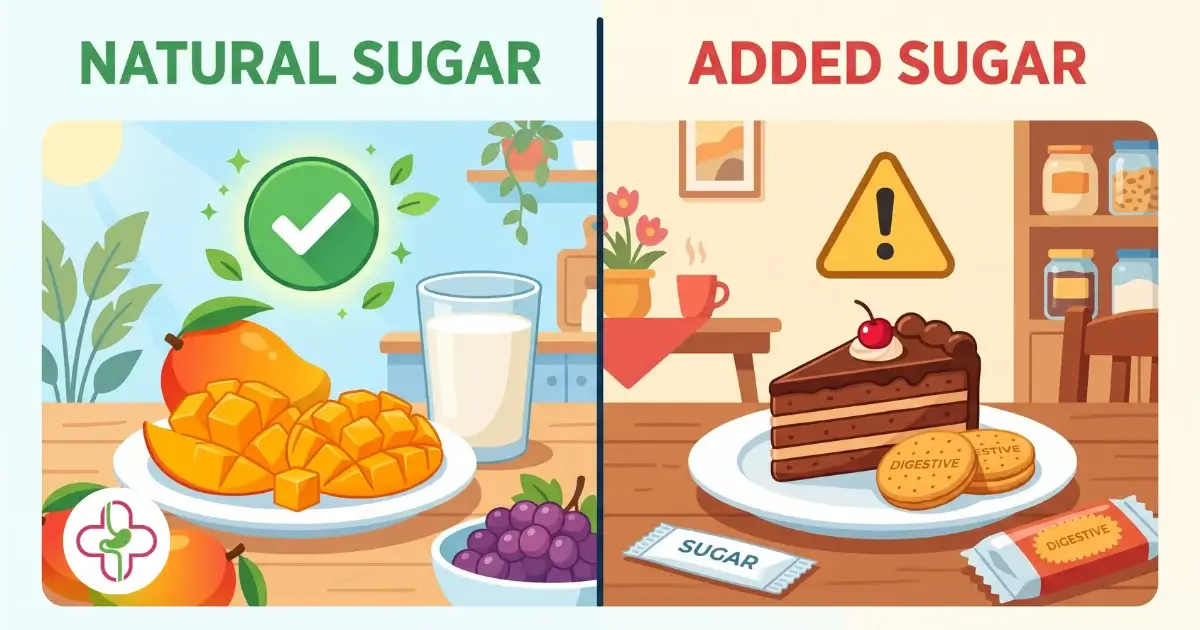
Not all sugar counts against this limit. Sugar that's naturally part of a food — in fruit, milk, or yogurt — is not the concern. What guidelines track is added sugar: sugar or syrup put into food during cooking or processing. That includes table sugar in tea, sugar syrup in mishti (rosogolla, gulab jamun, chomchom), condensed milk, cake, biscuits, and sweetened confectionery.
A mango or a glass of milk doesn't need to be limited the way a piece of cake does — the sugar comes packaged with fiber, protein, vitamins, or calcium, not on its own.
Why children's bodies handle sugar differently than adults'
A few reasons this matters more in childhood than it might seem:
- Heart and metabolic health, long term. Children who regularly get more than about 10% of their daily calories from added sugar tend to show higher LDL ("bad") cholesterol, higher triglycerides, lower HDL ("good") cholesterol, and this pattern is associated with a higher long-term risk of type 2 diabetes.
- Tooth decay adds up over a lifetime. Cavities (dental caries) from sugar exposure build cumulatively — the earlier and more frequent the exposure, the more it compounds. Even a small reduction in childhood sugar intake has a lasting effect on dental health.
- Sugar can crowd out a meal. A child who fills up on something sweet before a meal often eats less of the rice, dal, vegetables, or protein that meal was meant to provide.
None of this means one sweet is a problem — it's the regular, daily pattern that these risks are tied to, not an occasional treat. If your child already has a known risk factor (family history of diabetes, an existing weight or growth concern), it's worth discussing sugar intake specifically with your pediatrician rather than relying on general guidance alone.
What actually helps, day to day
- Offer fruit — banana, mango, papaya — as the everyday "sweet," and save mishti/cake for occasional or festive moments rather than daily habit.
- Don't frame sweets as forbidden or shameful. An occasional rosogolla at Eid or a birthday is fine — the goal is keeping it occasional, not eliminating it entirely.
- Watch the "invisible" sugar sources too — sweetened tea, flavored yogurt, and packaged biscuits often add up over a week more than the occasional mishti does.
What we don't recommend
Juice, sweetened drinks, and other packaged sugary beverages are not a safer way to give a child sugar — if anything, they're easier to overconsume than solid sweets and provide little to no fiber to slow that sugar down. Guidelines for infants specifically recommend avoiding juice and sweetened drinks entirely in the first year of life, and keeping them limited well beyond that. Our general approach: reach for whole fruit, milk, or homemade options — not bottled or packaged sweetened drinks — as the "better sweet."
A rough portion guide
These are approximate estimates for common sweets, based on standard recipe-nutrition analyses — not a lab-tested food composition database (Bangladesh and India's official food composition tables don't currently list these specific sweets) — meant to give a general sense of scale, not a precise count.
Roughly how much of the recommended daily limit (~25g) common sweets and snacks consume:
- 1 small rosogolla: About a third to half of the daily limit
- 1 piece of sandesh: About a fifth to a quarter of the daily limit
- 1 slice of cake: Can be half to more than the entire daily limit
- 2 sweet biscuits: About a fifth to a quarter of the daily limit
The takeaway isn't to count grams obsessively — it's to notice that a single festive sweet or bakery slice can already account for most or all of a day's allowance, so what comes after it (tea with sugar, a biscuit, a soft drink) adds up fast.
A note from Dr. Rafia Rashid
Dr. Rafia Rashid is a pediatrician and pediatric gastroenterologist (FCPS, Pediatrics; FCPS, Pediatric Gastroenterology & Nutrition) with over 18 years of experience, and Assistant Professor at Bangladesh Shishu Hospital & Institute. In her practice, she guides families toward realistic, culturally sensible ways to manage sugar intake — without turning food and festivals into a source of guilt.
Frequently Asked Questions
Is fruit sugar the same as added sugar?
No. Sugar naturally present in fruit, milk, or yogurt is not counted against the daily added-sugar limit. It's sugar added during cooking or processing — in mishti, cake, biscuits, and sweetened drinks — that guidelines track.
Is jaggery (gur) a healthier alternative to white sugar?
Not meaningfully, for this purpose. Gur is still added sugar and counts toward the same daily limit, even though it carries small amounts of minerals white sugar doesn't.
How much added sugar can a toddler under 2 have?
None, ideally. Guidelines recommend avoiding added sugar entirely for children under 2, including in drinks and snacks.
Is it okay for my child to have mishti during Eid or a birthday?
Yes — occasional festive sweets are fine. The concern is daily, habitual sugar intake, not a sweet enjoyed at a celebration once in a while.
What about fruit juice — isn't that a healthy way to give my child sugar?
No. Even 100% fruit juice concentrates sugar and removes the fiber that would normally slow its absorption. Whole fruit is the better choice, and juice/sweetened drinks should be avoided in the first year and kept limited afterward.
References
- World Health Organization. Guideline: Sugars Intake for Adults and Children, 2015 — recommends limiting free sugars to less than 10% of total energy intake, with further reduction to below 5% for additional benefit.
- Vos MB, et al. "Added Sugars and Cardiovascular Disease Risk in Children: A Scientific Statement From the American Heart Association." Circulation, 2017 — recommends ≤25g (~6 tsp) of added sugar per day for children 2–18, and avoiding added sugar under age 2.
- American Academy of Pediatrics / HealthyChildren.org — added sugar guidance for children, cholesterol and type 2 diabetes risk associated with high added-sugar intake.
- National Dietary Guidelines for Bangladesh, Directorate General of Health Services (DGHS), 2025 — Guideline 4 (reduce sugar, sweets, sweetened drinks) and Guideline 1 (avoid juice/sweetened drinks in the first year; complementary foods should have no added sugar).
- Portion-guide sugar estimates for rosogolla, sandesh, and cake are drawn from standard recipe-nutrition calculators, cross-checked for consistency. Neither Bangladesh's nor India's official food composition databases currently include lab-verified entries for these specific sweets; figures here are directional, not clinical-grade measurements.
This article is for general information and does not replace individual medical advice. Sweet-portion estimates are approximate and meant as a general guide, not a precise nutritional calculation. If your child has a known risk factor for diabetes or growth concerns, discuss sugar intake specifically with your pediatrician.