
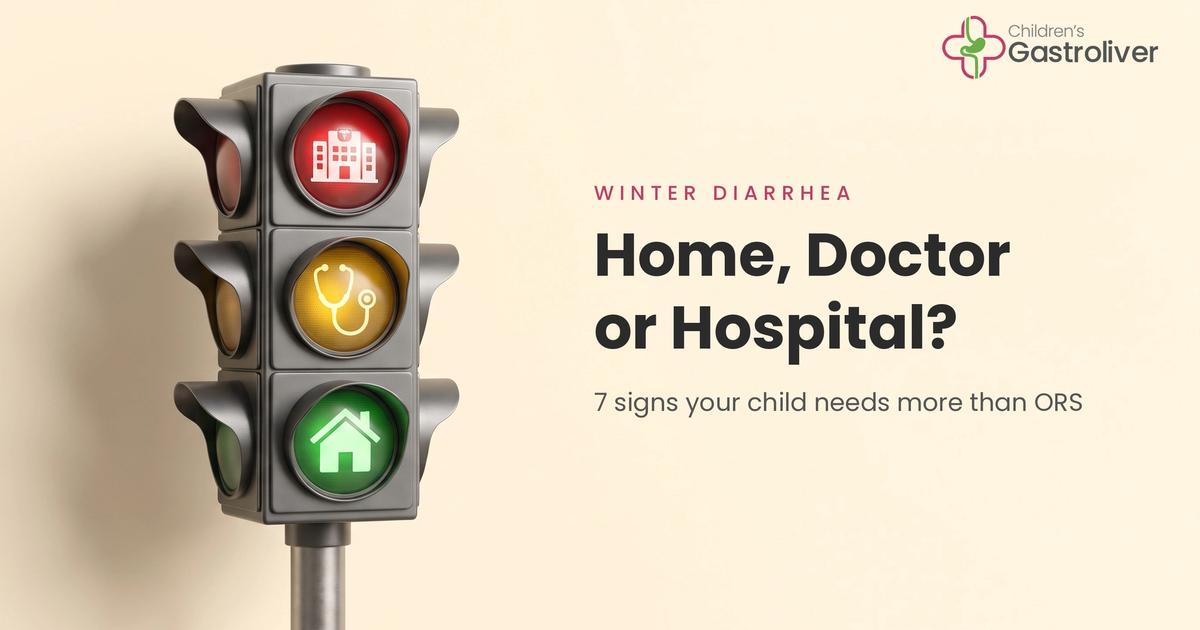
Most winter diarrhea in children can be managed safely at home with ORS, zinc and continued feeding. But take your child to a hospital right away if they are unusually sleepy or hard to wake, cannot drink or vomit everything, are passing very little urine, or have blood in the stool. Babies under 6 months can dehydrate faster, so get them checked sooner.
Every winter, Dhaka's children's hospitals fill up with diarrhea cases. In just the first four days of January 2025, Bangladesh Shishu Hospital & Institute treated 155 children with diarrhea, and around 60% of the diarrhea cases at icddr,b that season were caused by rotavirus. (We explained why this happens in Why Does Diarrhea Increase in Winter?) Doctors pointed to a familiar problem: many children are brought to hospital only after their condition has become serious. This guide shows you what to look for, so you know when home care is enough — and when it isn't.
Why dehydration — not the loose motions — is the real danger
Diarrhea itself is rarely what harms a child. The danger is the water and salts lost with every watery stool and every bout of vomiting. Rotavirus, the most common winter cause, often brings both at once. That is why a child can go from "just loose motions" to dehydrated within a day. Small children have less fluid in reserve, so they dehydrate faster than adults.
This is exactly what ORS is for: it replaces the lost water and salts. It does not stop the loose motions — and that is fine. (More on this in The Truth About ORS vs. Costly "Probiotic Saline".)
How to check your child for dehydration in one minute
The World Health Organization (WHO) uses four simple checks. You can do all of them at home:
- Alertness: Is your child their usual self, restless and irritable, or unusually sleepy and floppy?
- Eyes: Do the eyes look more sunken than usual? If you are unsure, ask a family member who sees your child every day.
- Thirst: Is your child drinking normally, drinking eagerly as if very thirsty, or hardly able to drink at all?
- Skin pinch: Gently pinch the skin of the belly, halfway between the navel and the side. Hold for one second, then let go. Normally it flattens straight away. If it goes back slowly, that is a warning sign. If it takes more than 2 seconds, that is serious.
Also keep an eye on urine. A child who passes urine regularly is usually getting enough fluid. Passing urine only once or twice in a whole day is a sign of severe dehydration.
If your baby wears diapers: modern diapers soak up urine so well that it is easy to miss a dry spell, especially if the same diaper stays on for many hours. While your baby has diarrhea, check the diaper every 2–3 hours — a wet one feels heavier and puffier. If you can't tell, switch to a cloth nappy (kantha) for a day or two, so you can see clearly whether your baby is passing urine.
Three levels: home, doctor today, hospital now
Manage at home: no signs of dehydration
Your child is alert, drinking normally, passing urine, and playing between episodes. Continue with:
- ORS after every loose stool: about 50–100 ml (a quarter to half a cup) for children under 2 years, and 100–200 ml (half to one cup) for children aged 2–10 years. Older children can drink as much as they want.
- Zinc for 10–14 days, as recommended by WHO and UNICEF — even after the diarrhea stops.
- Keep feeding, including breastfeeding — even more often than usual.
See a doctor today: some dehydration
If you notice two or more of these signs, see a doctor the same day:
- Restless or irritable
- Sunken eyes
- Drinks eagerly, seems very thirsty
- Skin pinch goes back slowly
Also get your child checked without delay if your baby is under 6 months old, if there is a fever, or if the diarrhea has lasted 14 days or more.
Go to a hospital now: the 7 warning signs
Do not wait for clinic hours if you see any one of these:
- Very sleepy, floppy or hard to wake — or cold, blotchy hands and feet.
- Cannot drink or breastfeed, drinks very poorly, or vomits everything, including ORS.
- Sunken eyes together with a very slow skin pinch — the skin takes more than 2 seconds to flatten.
- Very little urine — only once or twice in a day.
- Blood in the stool.
- A seizure or convulsion (খিঁচুনি) — stiffening or jerking of the body, or eyes rolling up — or any fever in a baby under 3 months old.
- Green vomit, or a swollen, hard or very painful belly. These can signal a blockage in the gut and need urgent assessment.
What not to do while you wait or travel
- Don't stop ORS because of vomiting. Wait 10 minutes, then give it more slowly — one spoonful every 2–3 minutes. Small, frequent sips often stay down when a full cup does not.
- Don't give medicines to "stop" the diarrhea. WHO advises that anti-diarrhea drugs should never be given to young children, and some of them are dangerous.
- Don't start antibiotics on your own. Most winter diarrhea is caused by viruses, and antibiotics do not help. A doctor will prescribe one if it is needed — for example, for bloody diarrhea.
- Don't replace ORS with soft drinks, packaged juice or glucose drinks. The extra sugar can pull more water into the gut and make diarrhea worse.
- Don't stop feeding once your child is able to eat.
Getting care in Dhaka
Go to the nearest hospital emergency department. For children in Dhaka, options include:
- Bangladesh Shishu Hospital & Institute, Sher-e-Bangla Nagar
- Bangladesh Medical University (BMU), Shahbag
- icddr,b's Dhaka Hospital, Mohakhali
- Government medical college hospitals, such as Dhaka Medical College Hospital, Sir Salimullah Medical College Mitford Hospital and Shaheed Suhrawardy Medical College Hospital
On the way:
- Keep giving sips of ORS from a cup or spoon.
- Keep breastfeeding if your baby will feed.
- Note down how many loose stools and vomits your child has had in the last 24 hours, when they last passed urine, and any medicines already given. This helps the doctor decide quickly.
Please note: Children's Gastroliver Center is an evening outpatient clinic, not an emergency service. If your child has any of the 7 warning signs, go straight to a hospital — don't wait for an appointment.
A note from Dr. Rafia Rashid
Dr. Rafia Rashid is a pediatrician and pediatric gastroenterologist (FCPS, Pediatrics; FCPS, Pediatric Gastroenterology & Nutrition) with over 18 years of experience, and Associate Professor at Bangladesh Shishu Hospital & Institute. Every winter, she helps families tell the difference between diarrhea that can be cared for safely at home and dehydration that needs a hospital — a difference parents can learn to spot with the simple checks above.
If your child's diarrhea keeps coming back, lasts more than two weeks, or is affecting their weight or appetite, a consultation with a pediatric gastroenterologist can help find the cause.
Frequently Asked Questions
How can I tell if my child is dehydrated?
Check four things: alertness, eyes, thirst and a skin pinch on the belly — plus how often your child passes urine. Restlessness, sunken eyes, eager drinking and a slow skin pinch mean some dehydration, so see a doctor today. Being very sleepy, unable to drink, or a skin pinch slower than 2 seconds means severe dehydration — go to a hospital now.
How long can a child go without passing urine?
There is no single safe number of hours for every age, so watch the pattern over the day. Passing urine only once or twice in a whole day is a sign of severe dehydration and needs a hospital. If your baby wears diapers, check every 2–3 hours by feel — or use a cloth nappy while your baby is ill — because a long-worn diaper can hide the fact that your baby has stopped passing urine.
My child vomits the ORS. What should I do?
Wait 10 minutes, then give ORS slowly — one spoonful every 2–3 minutes. If your child vomits everything and cannot keep any fluid down, go to a hospital.
Is diarrhea with vomiting more dangerous?
It can be, because your child loses fluid both ways and may struggle to drink. Rotavirus often causes both. Keep offering small sips of ORS and watch closely for the 7 warning signs.
Is blood in the stool always an emergency?
Yes — it should be seen by a doctor urgently. Blood in diarrhea can mean a bacterial infection that needs a specific antibiotic, or another problem that needs checking.
References
- World Health Organization. The Treatment of Diarrhoea: A Manual for Physicians and Other Senior Health Workers, 4th revision. Geneva: WHO; 2005.
- World Health Organization & UNICEF. Integrated Management of Childhood Illness (IMCI) Chart Booklet. Geneva: WHO; 2014.
- World Health Organization & UNICEF. Joint Statement: Clinical Management of Acute Diarrhoea. 2004.
- World Health Organization. Diarrhoeal disease — fact sheet.
- American Academy of Pediatrics. Dehydration. HealthyChildren.org.
- American Academy of Pediatrics. Fever and Your Baby. HealthyChildren.org.
- "Surge in child patients demands proper response" (editorial). The Daily Star, 6 January 2025.
This article is for general information and does not replace individual medical advice. If you are worried about your child, contact a doctor or go to the nearest hospital.